
About Me
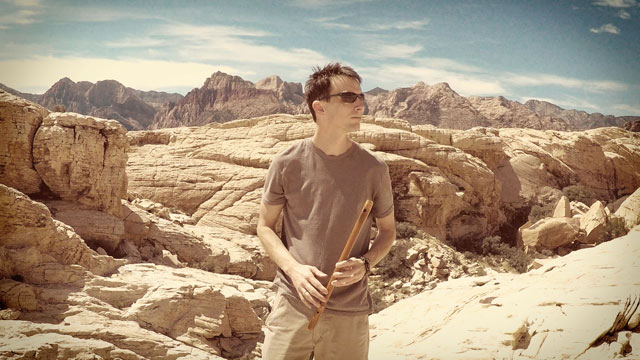
Being Artist-in-Residence in Nevada. 2015.
See my Artist Resume / CV (pdf) for details.
Rural Space Music
I compose and improvise original music for instruments that I build and play myself such as chromatic dulcimers, mountain dulcimers , electric gourd, and tone hole flutes, mostly made of bamboo and gourds. I also utilize instruments built by others: guitars, banjo, ukulele, harmonica, synths, and generative music systems. I sometimes experiment with granular synthesis.
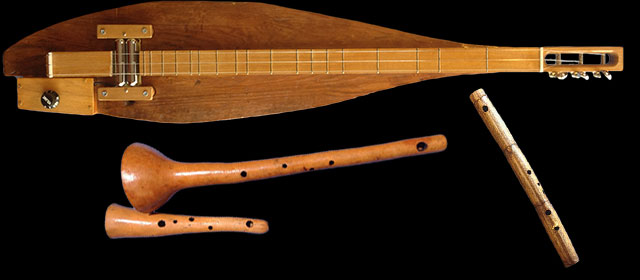
I perform and record my instrumental music both solo and with my trio Twang Darkly. You can experience it on my my youtube channel, bandcamp page, in a variety of digital download/streaming stores, and at upcoming shows.
I fundamentally don't care about musical genre, but instead pursue a free-range approach of modal, polymodal, and impressionist ideas. But folks frequently ask "what kind of music do you play?" so I usually answer rural space music or interplanetary mountain music: playful terms meant to open more space than they delineate. Because a lot of what I do is improvisational, rural space music is a cousin of jazz (similar, for example, to the way that the very wide-ranging Bill Frisell, usually gets labeled as "jazz").
I sometimes make strange little films for my music or simply capture the recording sessions on video.
Recent Endeavors and Recognitions
I work out of Shreveport, Louisiana, where I am recognized by our regional arts council as a Northwest Louisiana Juried Roster Artist and Collectible Artist.
2020, Best in Show, Performing Arts, QuaranTime Exhibition, Shreveport Regional Arts Council
2019, Best in Show, Performing Arts, Critical Mass 7, Shreveport Regional Arts Council
In 2019, I was commissioned by visual artists Ben Moss and Jeromie Journell to create a musical soundscape to enhance their On the Margins exhibit at Artspace Shreveport.
In 2018, I used a mini-grant from Shreveport Regional Arts Council, along with a business enhancement grant from the Louisiana Division of the Arts, to stage New Research in Rural Space Music, a public recording session event.
In 2017, I was Midsummer Music Artist-in-Residence for ARNA in Sweden.
In 2016, I composed and performed music for "Do Si Do Boom Boom" segment of the Shreveport stage show Nick Cave AS IS. Later in the year, I worked with Bossier City salvage artist Steve Zihlavsky to stage a multimedia museum exhibit, The Court of King Skebal at Meadows Museum of Art, which was supported in part by a grant from the Shreveport Regional Arts Council with funds from the city of Shreveport.
In 2015, I was an official Artist-in-Residence at Red Rock Canyon National Conservation Area in Nevada, and received the Music Fellowship from the Shreveport Regional Arts Council. This work led to my involvement with the Landscape Composers' Network.
In 2014, I created Martian Archaeology, presented both as multimedia performance and album; this work was supported through an UNscene New Work Grant from the Shreveport Regional Arts Council.
I've done some score work for a few films, including the original score for an independent Hollywood feature, Counting for Thunder.
Back in the Day
I come from 1970s rural North Carolina, where I grew up with a fascination for the landscape and culture of the Appalachian Mountains, a trip to another world that we often undertook. Other worlds also fascinated me, with my other interests revolving around sci-fi, fantasy, and NASA. I'm a big fan of the writer Manly Wade Wellman, who interwove the rural and the fantastic in his stories. I'm also something of a Sun Ra geek.
See also:
- music releases
- youtube/michaelfutreal
- bandcamp.michaelfutreal.com
- facebook/twangdarkly (music)
- facebook/michael.futreal (personal)
- instagram/michaelfutreal
- mastodon/@twangdarkly (sunny.garden)
- pinterest.com/michaelfutreal
(This page discusses my musical background. I also do web and multimedia consulting.)
served from michaelfutreal.com