
Mountain Dulcimer
I play mountain dulcimer (also called Appalachian dulcimer ), as well as a related instrument, the chromatic dulcimer. I built some of the mountain dulcimers I play; others others come from from a variety of makers, including Folkcraft. I use these instruments both solo and with with my trio Twang Darkly.
If you're interested in connecting with other dulcimer enthusiasts to discuss the instrument and its possibilities, you can find a number online discussion groups including Friends of the Mountain Dulcimer.
About the Mountain Dulcimer
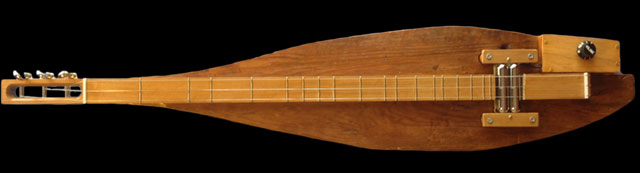
I built this dulcimer from a 19th century cypress wood ironing board
The mountain dulcimer is a fretted folk zither that is semi-indigenous to the mountainous areas of the eastern United States. The most complete history of the instrument of which I'm aware is Ralph Lee Smith's Appalachian Dulcimer Traditions. Evolved from older European instruments (especially, it seems, the German scheitholt), the dulcimer continues to evolve.
Features
The "mountain dulcimer" features a diatonic fretboard, usually with at least one additional note. That is, on any string you can only play all the notes of that open note's major scale with a substituted flat seventh (e.g., Mixolydian mode). Most contemporary models also include a major seven as well on the so-called 6 1/2 fret. This is not to say that you can only use a dulcimer to play music in Mixolydian or Ionian modes, however: far from it.
Beyond this, some dulcimer makers are starting to feature 1 1/2 frets (a flat third) on demand as well, and fully chromatic fret boards are also becoming more generally available, in which case the instrument is better referred to as a chromatic dulcimer.
The typical dulcimer is a zither — its strings are stretched across its body, which most usually extends the full length of the fretboard (as compared with lutes, where strings ride a neck that extends out from the body). Of course, there are dulcimer-related lutes as well, such as the strumstick.
Acoustic or Electric?
Generally, mountain dulcimers are acoustic instruments, but as with guitars, it's possible to build electric dulcimers, solid body instruments with magnetic pickups (which is what I do). Many acoustic makers also offer optional piezo-electric pickup systems on their instruments and sometimes refer to this arrangement as "electric" as well, though I think "amplified acoustic" would be a better way to describe this acoustic-with-piezo setup.
served from michaelfutreal.com